
After several years working together on my treatment, we now keep in touch for any questions and to adjust my medication.
Psychiatrist for traumatic brain injury (TBI)
A road traffic accident, a serious fall or a heavy blow to the head are traumatic events that happen in a matter of seconds, yet their consequences can profoundly change the life of a person and their family. It is completely natural to feel disorientated and afraid of the unknown.
Often, after being discharged from hospital, it seems the worst is over because the physical injuries have healed. However, it is in everyday life that the “invisible scars” begin to show. At Dr. Sánchez Menéndez‘s practice, we understand the complexity of acquired brain injury and provide medical support to treat the changes in personality, the impulsivity and the emotional difficulties that arise after the accident.
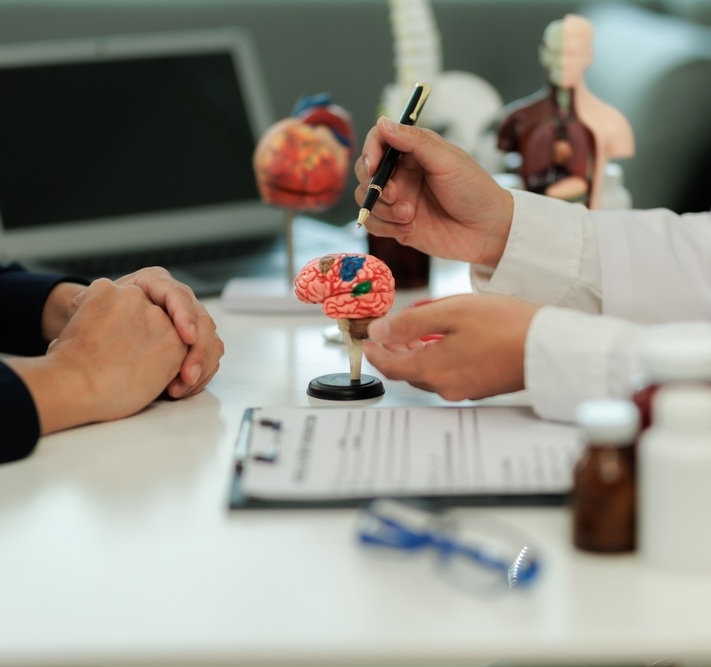
The “invisible” after-effects of a head injury
Brain injury is often not visible from the outside, which leads to a great deal of misunderstanding among the people around the patient. Families often say that their loved one “is no longer the same person”. Understanding that these changes are medical symptoms, not deliberate behaviour, is the first step towards recovery.
Personality changes and poor impulse control
This is one of the most common after-effects and one of the hardest to manage at home. Especially when the damage affects the frontal lobe (the part of the brain that acts as our social “brake”), the patient may become disinhibited, say inappropriate things or show serious problems with impulsivity and aggression. Through psychiatric treatment, we are able to regulate these impulses and bring peace back to family life.
Cognitive difficulties and memory problems
After a TBI, it is common for processing information to take more effort. The person may struggle to concentrate, suffer extreme mental fatigue with everyday tasks or have difficulty remembering recent conversations. These cognitive losses often cause deep frustration, as well as anxiety or depression, which we need to treat so that rehabilitation can move forward.
Our comprehensive assessment method
We know that mobility can be a challenge after a stroke. That is why we have designed a flexible care process, adapted to your new reality, so that accessing medical care is as easy as possible.
1.
Fill in the contact form with your details. In your message you can mention whether the patient has mobility difficulties or problems speaking (aphasia) after the stroke, so that we can take it into account.
2.
We schedule an appointment. Our team will get in touch with you quickly to find the most suitable time, taking into account the schedule of your other rehabilitation therapies.
3.
On the day of the appointment, you can choose to come in person or have the consultation online from home, via a very simple link. This way we avoid unnecessary journeys and assess the situation in complete comfort.


M.H. Patient
My trusted psychiatrist for years
F.A. Patient
An excellent professional, caring and a great communicator
I’m very happy to have found someone like him. He is helping me a lot with my problems.
Frequently asked questions
What is a traumatic brain injury (TBI) and how does it affect the brain?
What is a traumatic brain injury (TBI) and how does it affect the brain?
We speak of a traumatic brain injury (TBI) when the brain suffers a violent impact against the inside of the skull. This sudden jolt can damage nerve fibres and disrupt the way different areas of the brain communicate with one another.
The brain is the conductor of everything we are: our personality, our memories and our emotions. That is why, when it suffers sudden damage, it is not only physical functions that are affected; the very essence of the person may seem different. Our goal is to help the brain stabilise and reconnect.
My relative has become very aggressive since the accident. Will they ever be the same again?
My relative has become very aggressive since the accident. Will they ever be the same again?
Aggression after a TBI is caused by inflammation and damage in the areas of the brain that control behaviour. As the swelling goes down and the brain recovers over the first few months, and with the help of suitable medication to control impulsivity, aggression usually decreases significantly. Although full recovery depends on how severe the damage is, quality of life and family life improve greatly with the right intervention.
How long does recovery from a traumatic brain injury take?
How long does recovery from a traumatic brain injury take?
Recovery from brain injury is a long process. The fastest changes are usually seen during the first 6 to 12 months after the injury, when the brain has the greatest capacity for neuroplasticity. However, improvement can continue slowly for years. It is a marathon, not a sprint, in which patience and medical support are essential.
The patient does not accept that they have a problem. What can we do?
The patient does not accept that they have a problem. What can we do?
This is called “anosognosia” and it is a very characteristic symptom of brain injury. The brain is unable to process that it is damaged, so the patient refuses help or gets angry when corrected. In these cases, professional guidance for the family is vital to give you management strategies, avoiding direct confrontation and getting them to attend an appointment framed as a general check-up.